The Complete Guide to HTMA Testing and Why It Matters
May 1, 2026
If you’ve been doing all the “right” things, like eating well, taking supplements, managing your stress, sleeping more, but you still feel exhausted, anxious, foggy, or like something is just “off”, there’s a good chance the answer is hiding in your minerals.
Minerals are involved in literally everything your body does. Metabolism, building bones, transporting oxygen, hormone production, digestion, immune function, detoxification, muscle contraction, nervous system regulation… and the list goes on and on!
There’s one test I use with every single on of my clients to assess mineral status and map out patterns of dysfunction: Hair Tissue Mineral Analysis (HTMA).
This post covers how HTMA helps the clients in my practice stop chasing hormone imbalances and start rebuilding their foundation so they can address health concerns at the root.
What HTMA actually is
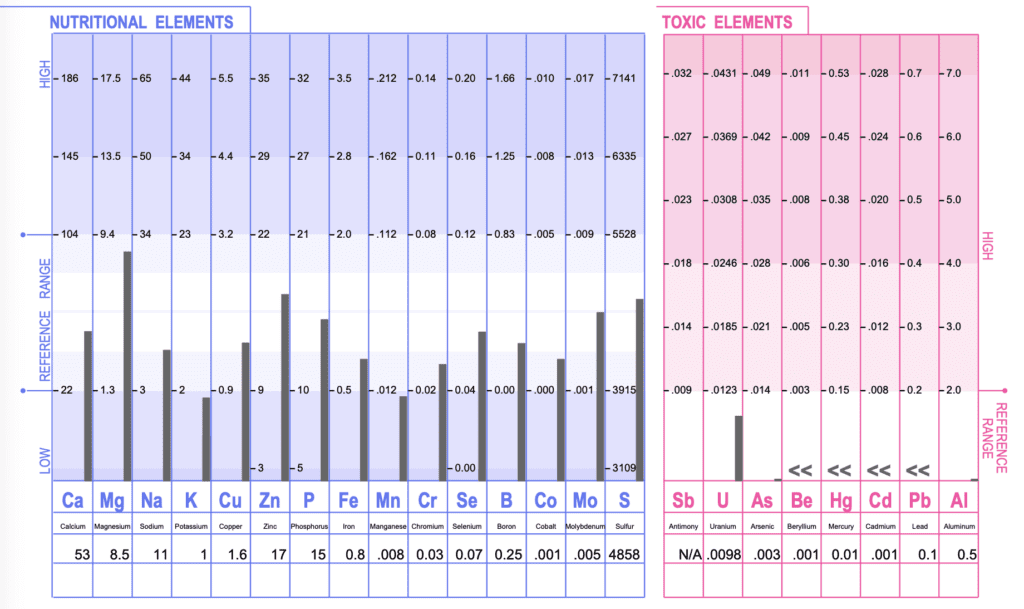
It’s a lab test that measures the mineral accumulation in the hair. You take a small sample from the back of your head and close to the scalp, which gives us insight into your cellular mineral status over the past several months. This acts as window to your body’s energy system and helps identify which areas of the body need the most support first, like digestion, hormones, blood sugar, inflammation, adrenals, etc.
HTMA is a screening test, not a diagnostic test. Meaning, it gives us information to inform a protocol, not a diagnosis. And the truth is, you don’t need a diagnosis to feel better. But you do need to recognize patterns that are keeping you stuck.
Why bloodwork isn’t enough
Your blood is a transport system that constantly delivers resources to tissues throughout the body. Its job is to keep specific levels of nutrients within an extremely tight range so your body can keep functioning. If your blood calcium drops even slightly, your body will pull calcium from your bones to maintain blood levels. If your blood magnesium drops, your body will pull from cells, muscles, and tissue to keep your blood levels stable.
So, when your bloodwork comes back showing “normal” serum magnesium, that doesn’t mean your tissues have enough magnesium. It means your body is doing whatever it has to do to keep your blood levels stable while the cells in your tissues could still be running on fumes.
This is why so many women with raging mineral deficiencies have bloodwork that looks fine. Blood is the wrong place to look. By the time a deficiency shows up in a serum test, it’s usually been a problem in your tissues for YEARS.
HTMA looks at the tissue level and fills that gap.
What an HTMA shows you
A standard HTMA reports different layers of information:
Mineral levels. The absolute amount of essential minerals in your hair sample — calcium, magnesium, sodium, potassium, iron, copper, zinc, manganese, chromium, selenium, phosphorus, boron, sulfur, and more.
Toxic metals. Mercury, lead, aluminum, arsenic, cadmium, nickel, and others. This shows what your body has been excreting and, in many cases, what’s been stored in tissue from past or current exposures. Heavy metals can displace minerals in the body by competing for the same binding sites, so this information helps us makes sense of why some mineral levels appear low. (And we’re all exposed to heavy metals in the modern world, whether we like it or not!)
Mineral ratios. Minerals work in relationships, which means the status of one mineral can affect that status of other minerals. So, the ratios between minerals tell you how your body is actually using them. This gives us insight into your thyroid function, how well you’re regulating blood sugar, your adrenal status, immune function, and how well you’re handling the demands being placed on your body overall.
Patterns. Specific combinations of minerals and ratios point to recognizable patterns. Are you a fast metabolizer or a slow metabolizer? You do have a calcium shell that could be preventing your cells from utilizing thyroid hormone? Are your four main minerals low due to prolonged stress? Do you have a sodium/potassium “inversion” that could indicate tendencies toward exhaustion, cravings, allergies, digestive insufficiency, or other issues? Each pattern tells a different story about what your body has been doing to adapt to stress, what it’s running out of, and what it needs to recover.
The point isn’t the numbers in isolation. The point is the pattern. Because that’s where you start to see why you’re presenting with symptoms, even if you’re doing everything else “right.”
Who HTMA is for
It might be time to run an HTMA if:
– You know you don’t feel well, but you keep getting “normal” lab results or leaving appointments feeling like your body doesn’t make sense.
– Your digestive symptoms and hormone imbalances have persisted despite clean eating, exercising, and trying to do everything “right.”
– You’re experiencing chronic stress, burnout, or deep fatigue and exhaustion, but you don’t know where to start to bring your body back in to balance.
– You have known hormone imbalances (PMS, irregular cycles, low libido, estrogen dominance, PMOS, endometriosis, thyroid issues, etc.) that haven’t budged with diet or supplements.
– You’re overwhelmed by conflicting nutrition advice and stuck in a cycle of trying new protocols, and you’re tired of guessing.
If you’ve ever felt like you’re missing a piece of the puzzle, HTMA just might be it!
How to prepare for HTMA testing
Cutting a hair sample sounds scary for some, and I get it. But the sample isn’t as scary as it sounds.
– You’ll need a heaping teaspoon of hair (the lab provides a scale to help you measure this).
– Your sample should include only the first ½-1 inch of hair that’s closest to the scalp (the newest hair for the most recent mineral data), so it should be cut as close to the scalp as possible, and the ends of the hair are not sent to the lab.
– You can take the sample from several locations on the back of your head, so it doesn’t have to come out all in one chunk.
– The hair should be dye-free, so it’s best to wait at least 6-8 weeks after the last round of hair dye to take the scalp sample.
– If you have hard water, it’s best to wash and rinse your hair with distilled water prior to taking the sample.
I always ask my hair stylist do this for me before she dyes it. They’re very good at taking samples from the same parts of your head that they would put extensions, and can cut in thin, clean lines that are really not noticeable!
What happens after the results
A good HTMA workup doesn’t end with a printout. It ends with a protocol that’s specific to your patterns.
Mineral support is not as simple as “take magnesium.” Pushing one mineral when you have a depleted antagonist or a stuck adrenal pattern can backfire badly. This is why I never recommend DIYing HTMA interpretation off a Google search or using AI. The patterns are too interconnected to handle without someone who’s been trained to see them and connect them back to your symptoms.
The good news: when you finally start supporting your minerals, the changes often don’t take long to come through. Energy comes back. Sleep deepens. Anxiety quiets. Cycles regulate. Cravings fade. Hair starts growing in. Digestion calms down.
The foundation that was missing finally gets rebuilt!
The bottom line
HTMA is one of the few tests that shows you what’s happening at the tissue level — where your symptoms are actually being generated. It catches the depletion, the imbalance, the stress patterns, and the heavy metal burden that conventional testing isn’t designed to find.
If you’ve been doing everything right and still feel like something is off, your minerals are one of the first places I’d look.
______
Ready to stop chasing symptoms and get to the root?
If you’re ready to find out what your minerals are actually doing and build a protocol that addresses the root, HTMA is included in my signature Balanced Body Roadmap program.
If you’re not ready to commit to the full program, I offer a one-time HTMA consult that you can book here.
______
Want root-cause health insights delivered straight to your inbox?
Sign up for my wellness newsletter for deeper dives on holistic hormone health, gut health, minerals, functional labs, and root-cause nutrition. Plus you’ll get first access to new offers, free resources, my favorite products, and insights that I only share with my email list.

